12 Natural Ways to Relieve Your Dental Anxiety

Dr. Jim Fox

Most of us would agree that the dentist’s office is no-one’s favourite place to be. E-v-e-r. Patients’ dental anxiety is real. In fact, research suggests that anywhere from 13% to 24% of the general population in North America has some level of dental anxiety (1)(2)(3)(4).


It is very important to Dr. Fox that his patients have fulfilling, comfortable and anxiety-free dental visits.…


Here we’ve put together a list of simple, natural ways for patients to help relieve their own dental anxiety. It is based on decades of first-hand patient experiences at Speedvale Dental Centre. A collaborative effort, the collection is put together by Dr. Fox, many of his patients, and his dental team at Speedvale Dental Centre.


We hope you find some of these suggestions helpful in relieving your own dental anxiety:


  1. Plan ahead and sleep well the night before your dental office visit
  2. Practice slow or ayurvedic breathing
  3. Get a massage before your dental office visit
  4. Watch what you eat beforehand – high protein foods like salmon, avocados, and yogurt have a calming effect
  5. Watch what you drink beforehand – avoid caffeine which can make you ‘jittery’
  6. Do aromatherapy beforehand
  7. Meditate / practice mindfulness – relaxation starts in the mind
  8. Do progressive muscle relaxation training – forehead, cheeks, jaw, neck, shoulders…
  9. Massage your jaw muscles when there is even a brief pause in your dental treatment
  10. Rub mint oil on the back of your neck – it’s relaxing and neutralizes that sterile “dental office smell”
  11. Bring along a friend or family member for moral support
  12. Enjoy a cup of an herbal tea blend beforehand to calm your nerves and relax your jaw and neck muscles


References:

(1) White A, Giblin L, Boyd L, The Prevalence of Dental Anxiety in Dental Practice Settings: American Dental Hygienists Journal. 2017;91(1):30-34.

(2) Armfield JM, Heaton LJ. Management of Fear and Anxiety in the Dental Clinic: A Review. Aust Dent J. 2013: 58 (4):390-407.

(3) Vanschaayk MM et al. The Prevalence of Dental Anxiety and its Association with Pain and Other Variables Among Adult Patients: BMC Oral Health. 2018; 18:101-113.

(4) Tellez M, Kinner DG, Heimberg RG, Lim S, Ismail AI. Prevalence and Correlates of Dental Anxiety in Patients Seeking Dental Care. Community Dent Oral Epidemiol. 2015; 135-142.


November 23, 2025
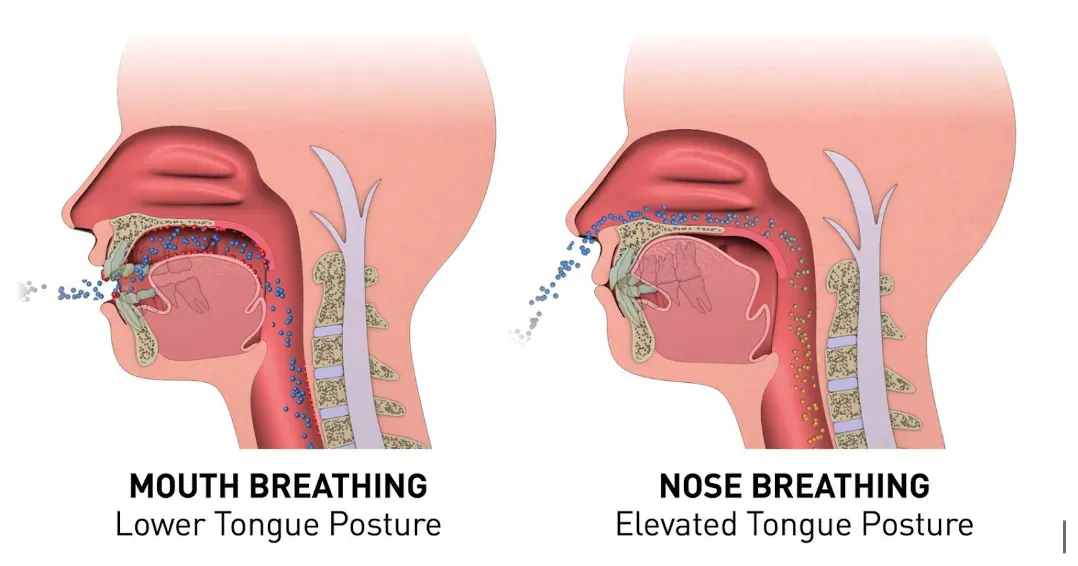
Did you know how you breathe can shape your oral health, facial growth, and even your sleep quality? As dental and myofunctional professionals, we see every day how something as simple as mouth breathing can lead to big changes in the way the face and jaw develop — especially in children. Understanding the difference between nose breathing and mouth breathing is one of the most important steps toward achieving better oral function, posture, and long-term health. Why Nose Breathing Is So Important From a myofunctional therapy standpoint, nasal breathing is ideal for both function and development. Here’s why: 1. It supports proper tongue posture. When you breathe through your nose, the tongue naturally rests against the roof of the mouth. This helps shape the upper jaw, maintain a wide dental arch, and promote a balanced facial structure. 2. It maintains a healthy oral environment. Nose breathing keeps the mouth closed and moist. This supports saliva flow, which helps prevent cavities, gum inflammation, and bad breath. 3. It encourages better sleep and airway function. Nasal breathing allows for efficient oxygen exchange and reduces snoring or nighttime airway collapse, improving both sleep quality and energy levels. 4. It guides healthy facial growth in children. For kids, consistent nasal breathing helps the jaws grow properly and teeth align naturally — reducing the need for extensive orthodontic treatment later. How Mouth Breathing Affects Oral Function When the mouth stays open for breathing, the entire oral system adapts to that posture — often in ways that create long-term problems: Low tongue posture: The tongue drops to the floor of the mouth, leading to narrow arches and crowded teeth. Dry mouth and higher cavity risk: Saliva flow decreases, allowing harmful bacteria to thrive. Changes in facial growth: Chronic mouth breathing can cause a longer face, narrow jaw, and weaker chin profile. Open mouth posture and poor lip seal: These habits can impact speech, swallowing, and appearance. Sleep-disordered breathing: Mouth breathing at night is often linked to snoring or mild sleep apnea. Why Mouth Breathing Happens There are several reasons people develop a mouth-breathing habit, such as: Nasal congestion or chronic allergies Enlarged tonsils or adenoids Structural nasal issues (like a deviated septum) Habitual open-mouth posture developed early in life Often, these issues start in childhood — and without correction, they can persist into adulthood. How Myofunctional Therapy Can Help Orofacial myofunctional therapy (OMT) is a series of exercises and techniques that retrain the muscles of the mouth, tongue, and face to work the way they’re meant to. Through myofunctional therapy, we focus on: Establishing nasal breathing as the default pattern Training proper tongue posture (on the palate) Developing a closed-lip resting position Coordinating correct swallowing and oral muscle function These changes don’t just improve breathing — they enhance oral health, support orthodontic treatment, and even improve facial balance and appearance. Breathe Better, Live Better If you or your child habitually breathe through the mouth, it’s not just a breathing issue — it’s a functional issue that can affect long-term health and development. At Speedvale Dental Centre, our team is trained in myofunctional therapy and airway-focused dentistry. We can help identify the root cause of mouth breathing and create a customized plan to restore proper oral function and healthy breathing patterns. Ready to take the first step toward better breathing and better health? Schedule a consultation today to learn how myofunctional therapy can help you or your child achieve optimal oral function — one breath at a time.
A woman is sitting on a yoga mat in a greenhouse.
By Dr. Jim Fox November 28, 2024
If you are concerned about your overall health and that of your family, and you believe that natural products and services are vital to one’s health, then full body health dentistry just may be the right option for you. Full body health dentistry, sometimes called biological, biocompatible, natural or integrative dentistry is certainly not a new approach to dental care. Nearly forty years ago (in 1978), the Holistic Dental Association was formed by a group of concerned, dedicated dentists interested in the development and sharing of long established and health-promoting treatment options. These were modes of dental treatment not included in western dental schools’ curriculums. These founding member dentists believed that most dental problems could be corrected and improved all while working in harmony with the body as a whole. Full body health dentistry recognizes the important connection between the health of the mouth and that of the entire body (as established by traditional medical research studies). This natural, comprehensive approach concentrates on the whole body health of the patient and not just the condition of the teeth and gums. The full body health dentist, when caring for a diabetic patient for example, will help that patient understand the best practices for home and dental office oral hygiene care and how, by following a healthy diet and exercise program, he or she can manage blood sugar levels best. The full body health dentist may work in tandem with other like-minded health professionals such as Naturopaths, Chiropractors, Acupuncturists, and Osteopaths in an integrative approach to ensure the highest level and most sustainable results. While dentists everywhere focus on dental health and the treatment of oral disease, not all dentists also focus on their patients’ whole body or general health. And, as more and more people seek out more natural health care options, full body health dentistry presents itself as a healthy comprehensive health care alternative with the perfect blend of modern dentistry and natural healing methods.
A clock is hanging on the wall above a speedvale dental reception desk.
By Dr. Jim Fox November 28, 2024
People often ask questions like: “what’s the difference between a full body health dentist and a traditional dentist?” or “how similar is a full body health dentist to a traditional dentist?” All dentists receive the same basic education and training in dental school, that is, the same theory and the same methods of practice to become what is commonly known as a ‘general’ dentist. Some of these general dentists may have further developed, through continuing education courses and training, a subspecialty like: family dentist, cosmetic dentist or full body health dentist. A full body health dentist offers conventional and complementary dental care. Unlike a traditional dentist, who may focus on one particular tooth or gum problem, the full body health dentist focuses on an individual’s whole body health. By identifying underlying imbalances in the body, a full body health dentist safely and effectively treats the problem with a combination of natural remedies and modern dental treatment. The full body health dentist is keenly aware of the best, most comprehensive long-term treatments necessary for restoring a patient’s oral and, ultimately, total health. Like that of a traditional dentist, a full body health dentist’s approach to care can vary from practice to practice. Following are a few differences between a full body health dentist and a traditional dentist: The full body health dentist refrains from using materials that many people feel are inferior. Materials such as silver mercury (amalgam) fillings may, according to the IAOMT , lead to a metallic taste, mouth ulcers, gum or other problems in some people. Rather, the full body health dentist only uses what he/ she believes are safer, more biocompatible materials. The full body health dentist may consent to a patient’s desire to have older, deficient fillings removed, especially if they exhibit an established sensitivity to that material. If so, they would do so with a safe, controlled procedure that minimizes the patient’s exposure to potentially harmful by-products. The full body health dentist typically uses only digital x-ray systems thereby reducing emitted radiation by, in some cases, as much as 80% over traditional x-ray systems. The full body health dentist approaches the need for root canal therapy with increased scrutiny and investigation. Root canal therapy is seen, in many cases, as a comforting yet transitional mode of treatment. The full body health dentist is aware that a tooth treated with root canal therapy may exist in a weakened state and, in cases where the root canal therapy on a tooth is failing, may expose the patient to recurrent, yet localized infections. The full body health dentist is sensitive to some patients’ concerns over certain in-office anti-cavity treatments and, then, may suggest a more natural alternative or herbal remedy. All Ontario dentists, regardless of their practice orientation, are required to separate waste amalgam (as a source of mercury) from their municipality’s wastewater. Beyond that, the full body health dentist is very environmentally conscious and responsible. The full body health dentist creates an office environment that is safe, biocompatible and minimally invasive to prevent potentially harmful effects on patients and dental personnel alike. When choosing between dentists, whether full body health or traditional, it is very important to select one whose philosophy on health complements yours.